Key Takeaways
Solidroad is the only platform here that scores 100% of conversations and closes the QA-to-training loop in a single product.
81% of conversations are never reviewed under manual sampling (State of CX 2026, 500 agents). That's the architecture problem Klaus and its alternatives work around rather than solve.
More than 1 in 3 enterprise contact centers have deployed AI support agents - making AI agent QA a non-optional evaluation criterion that most alternatives don't address.
Coverage model, AI agent readiness, and training integration matter more than feature checkboxes.
Solidroad leads this comparison because it’s the only platform that solves the architecture ceiling rather than working around it: 100% of conversations scored automatically, QA findings fed directly into personalized agent training, and no vendor conflict when scoring AI agents. At 1,000 agents, the 81% of conversations left unreviewed under manual sampling aren’t a resource problem - they’re the inevitable result of an architecture built for human reviewers at human speed. No amount of better scorecards fixes a sampling architecture.
Why teams switch from Klaus (now Zendesk QA)
If your enterprise contact center is re-evaluating Klaus after the Zendesk acquisition, the departure reasons matter - not to validate a decision you’ve already made, but to make sure you’re solving the right problem. Teams that leave because of pricing alone often land on a platform with the same architectural constraints. Teams that leave because of the sampling ceiling need something fundamentally different.
Three structural shifts drive most departures. First, pricing and roadmap priority shifted toward Zendesk-native workflows after Zendesk acquired Klaus on February 12, 2024 - teams using Salesforce, Intercom, or Freshdesk found the platform’s development direction now serves a competing stack.
Second, the manual sampling architecture was always a ceiling at enterprise scale. At 1,000 agents handling 100 interactions per week, a 1-5% sampling rate leaves 95,000+ conversations unmonitored every week. Klaus was built before AI-native scoring existed. What changed is that AI-native alternatives now do.
Third, teams running Zendesk Fin alongside Zendesk QA face a vendor conflict of interest. A QA platform owned by the same company that sells your AI agent has a commercial reason to minimize reported failure rates.
This article explores alternatives to Klaus (now Zendesk QA). Solidroad is our platform, and it appears first in this list. We’ve included honest limitations alongside strengths for every tool. The six alternatives were selected for enterprise relevance: minimum 200-agent operations, enterprise helpdesk integrations, and verified G2 review data.
Contact center QA software at a glance
The QA coverage model is what separates these Klaus alternatives - not pricing or integration lists. Solidroad and EvaluAgent score 100% of conversations; MaestroQA, Scorebuddy, and Level AI offer AI auto-scoring add-ons; Playvox uses manual QA as standard. Only Solidroad closes the loop from QA finding to agent training in the same platform.
Solution | Best For | QA Coverage | AI Agent QA | Training | G2 |
|---|---|---|---|---|---|
Solidroad | Enterprise teams needing 100% QA coverage + native agent training | 100% AI-automated; no manual sampling | Yes - any AI agent, real-time hallucination detection, no vendor conflict | Native QA-to-training loop | 4.5/5 |
MaestroQA (now Rippit) | Non-Zendesk helpdesks needing coaching analytics + screen capture for BPO | Manual sampling; AI Auto QA as add-on | Not native | Manual connection; no simulation | 4.6/5 |
Scorebuddy | Customizable scorecards + BI-grade reporting | Manual sampling; AI Auto Scoring as add-on | Not native | QA-to-coaching-to-learning flow; no simulation | 4.5/5 |
EvaluAgent | Compliance-heavy regulated industries needing full-coverage automated QA | Full coverage via Auto-QA add-on | Not native | Automated coaching workflows; no simulation | 4.5/5 |
Observe.AI | Voice-heavy enterprise (500+ agents) needing real-time agent assist | 100% voice + chat analysis; post-interaction QA | Not native | Real-time agent assist during live calls; no simulation | 4.4/5 |
Playvox | QA + workforce management in one platform | Manual QA standard; AI scoring less mature | Not native | No native simulation | 4.3/5 |
Level AI | AI-native QA with 100+ language support | Instascore targets 100%; reliability issues reported | Not native | Coaching dashboards; no simulation | N/A |
How to evaluate enterprise contact center QA software
Enterprise QA platforms need evaluation on five criteria generic guides miss: QA coverage model, AI agent governance, QA-to-training integration, migration complexity, and vendor acquisition risk.
Coverage model: Manual sampling tools review 1-5% of conversations. Automated QA scoring covers every conversation. At 1,000 agents, the 81% never-reviewed gap isn’t fixable with better scorecards - it’s an architecture problem, not a resource one.
AI agent governance: More than 1 in 3 enterprise contact centers have deployed AI support agents (State of CX 2026). Ask whether the QA platform scores AI agents without a vendor conflict of interest, in real time, with native hallucination detection.
QA-to-training integration: 53.5% of agents say applying training to real situations is the hardest part (State of CX 2026). Training simulations that auto-populate from QA findings close the loop automatically.
Migration complexity: Switching from Klaus takes 30-90 days. The process covers scorecard replication, parallel operation, historical data migration, and QA team retraining. Ask specifically about implementation SLAs.
Vendor acquisition risk: Klaus was independent until Zendesk acquired it in February 2024. Solidroad’s $25M Series A (April 2026, First Round Capital and Y Combinator) is an independent trajectory signal worth factoring into multi-year procurement.
The 7 best Klaus alternatives for enterprise
The entries below map each platform to its QA coverage model, AI agent readiness, and training integration approach - the three dimensions that separate the right choice from the wrong one at enterprise scale. Read each entry against your specific constraints: your helpdesk stack, your agent count, and whether you’ve deployed AI agents.
1. Solidroad (best for enterprise teams that need both QA and agent training in a single AI-native platform)
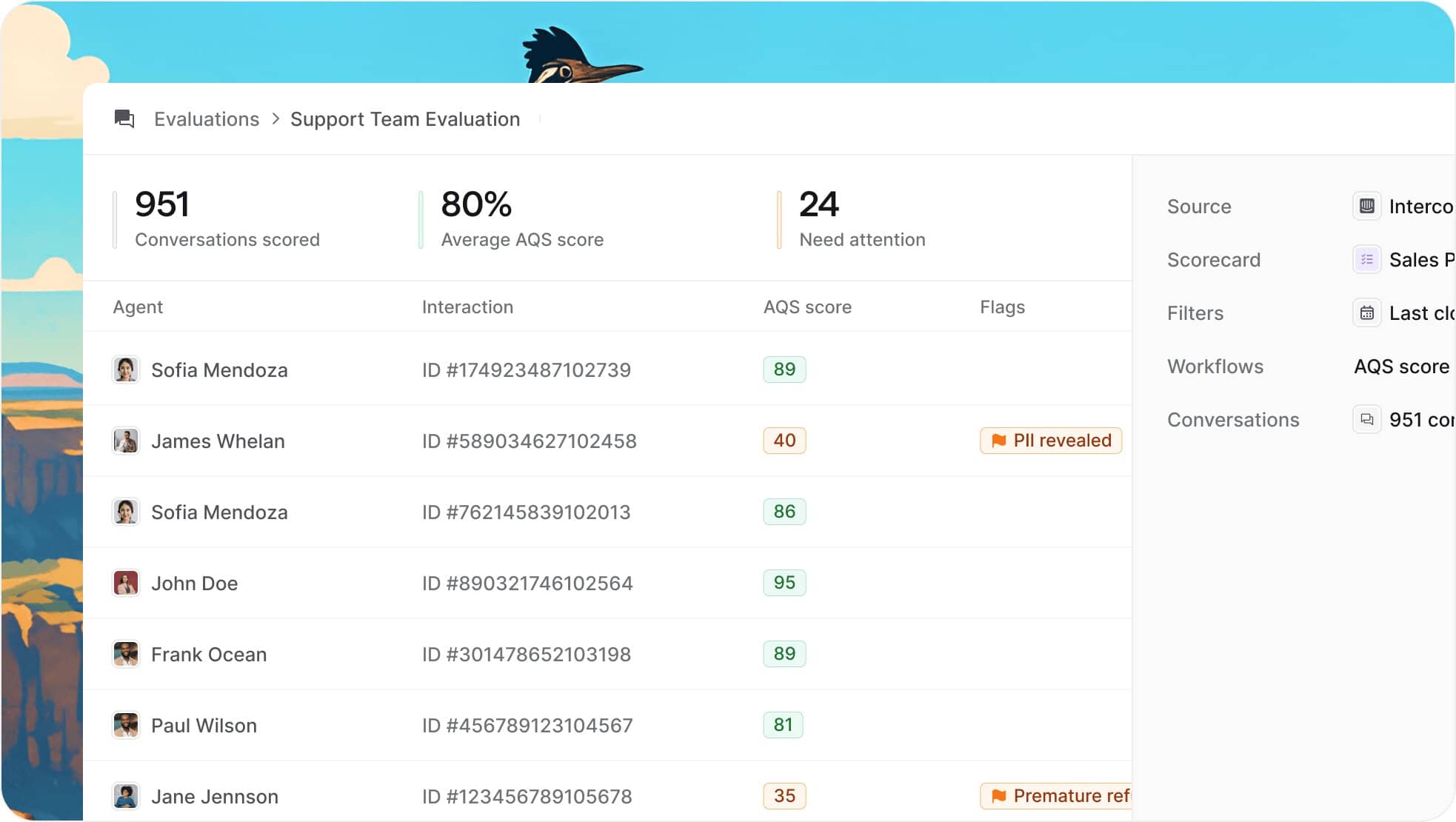
If the architecture ceiling is the reason you’re evaluating alternatives, Solidroad is the only platform in this comparison that solves it rather than optimizing within it. It scores 100% of conversations automatically and feeds QA findings directly into personalized training simulations - closing the loop that every other platform in this list leaves open.
Built on AI-native architecture from day one, Solidroad supports enterprise operations with SOC 2 Type 2 and ISO 27001 certification, and raised $25M in April 2026 as a vendor stability signal.
In our State of CX 2026 report - a survey of 500 customer support agents - we found that 81% of conversations are never reviewed under manual sampling. At 1,000 agents handling 100 interactions per week, that’s 81,000+ conversations per month invisible to QA. Compliance risks go undetected. Churn signals disappear. Coaching opportunities vanish before they can be acted on.
Solidroad’s scoring engine changes the architecture: every conversation scored automatically, every agent’s performance visible, every shift.
Teams at Fever, Oura, and Ryanair use Solidroad for this reason. Natalia García Jané, Senior Operations Manager at Fever: “We now have visibility into quality across 100% of interactions, not just a sample. And when we find gaps, we can verify they’re fixed before they affect more customers.”
Key differentiators
Solidroad’s coverage model isn’t built on sampling - it’s built on scoring every conversation. At 1,000 agents, a 5% sampling rate means 95 out of every 100 conversations never get reviewed. Solidroad’s AI scoring engine covers every interaction across every channel, every agent, every shift. Based on analysis of 3M+ conversations on our platform, the scoring model is trained on real enterprise contact center patterns - a 20x increase in QA coverage compared to manual approaches.
The scoring rubric is configurable to match your existing quality framework. Teams import their current scorecard criteria, calibrate the AI scoring against their standards, and run parallel scoring alongside human reviewers during onboarding to verify accuracy before full deployment. The result is an AI model tuned to your specific quality bar - not a generic one.
Finding quality problems without fixing them is a half-measure. Our survey found that 53.5% of agents say the hardest part of improving is applying training to real situations. Solidroad closes that loop: when QA scoring identifies an agent’s specific failure pattern, the system auto-populates that agent’s personalized training simulation queue with scenarios designed around their actual gaps. No manual translation needed. QA and training are one continuous system - resulting in 33% faster agent ramp.
When your QA platform and your AI agent belong to the same vendor, you have a structural conflict of interest. Solidroad doesn’t have a competing AI agent product - it scores Fin, Decagon, Sierra, and any AI support agent in real time, flagging hallucinations and policy violations before they affect more customers.
For enterprise teams in regulated industries, real-time compliance risk detection - flagged at the conversation level, not surfaced in a weekly report - is a meaningful difference from post-interaction-only platforms.
Key capabilities
100% conversation coverage across live chat, voice, email, and video
Native QA-to-training loop - findings auto-populate personalized training simulation queue
Real-time AI agent QA with hallucination and compliance risk detection
SOC 2 Type 2 + ISO 27001 certified
Integrations: Intercom, Zendesk, Salesforce, Freshdesk, HubSpot
$25M Series A (April 2026), backed by First Round Capital and Y Combinator
Limitations
Solidroad is a newer platform with a smaller customer base than MaestroQA or EvaluAgent - only 3 G2 reviews as of this writing, making peer-review volume a thin signal. Platform data (3M+ conversations scored) is the primary evidence anchor. Custom pricing needs a demo.
Initial rubric configuration takes setup time. For enterprise teams with established quality frameworks, calibrating the AI scoring against existing standards adds weeks to deployment.
What reviewers say
“Solidroad has significantly enhanced and refined our recruitment processes and training content, while providing engaging and effective assessments. Their dedication to partnership and their flexible, client-first approach have made them an invaluable extension of our efforts.” - Kellyn, Quantanite, via Product Hunt
“This tool saves us so much when it comes to time and human resources, and delivers high-quality results. We look forward to continuing to incorporate this into all our training and enablement programming for more effective, practical, and measurable results.” - via Product Hunt
2. MaestroQA (best for enterprise teams with non-Zendesk helpdesks that need data-driven coaching workflows and screen capture for BPO operations)
MaestroQA (now rebranded to Rippit) is the most analytically powerful coaching platform in this comparison. Its performance dashboards rival dedicated BI tools for QA use cases, and it’s the only platform here with screen capture - a must-have capability for BPO teams that need to review agent screen activity alongside call transcripts.
Key capabilities
AI Auto QA with extensive customization
Screen capture (unique in the alternatives set - BPO differentiator)
Gamified leaderboards and coaching session management with trackable action items
Unlimited customizable QA scorecards
Integrations: Zendesk, Salesforce, Intercom, Front, Kustomer
Strengths
MaestroQA’s performance dashboards rival dedicated BI tools - one reviewer described them as exceeding “the experience you would have with a Looker or Tableau UI” for QA analytics. Screen capture is the only such feature in this comparison. Customer support during implementation is consistently praised.
Limitations
Implementation is lengthy and labor-intensive - multiple reviewers cite timeline as the primary concern. Features are architecturally interwoven: removing a scorecard means untangling dashboards and automations built on top of it. No native training simulation. The Rippit rebrand (March 2026) reduces roadmap visibility. Even with AI Auto QA, the underlying architecture is manual-sampling-plus-AI, not full-coverage.
What G2 reviewers say
“Coming from a previous vendor whose tool is very user-friendly BUT limited in a number of ways, MaestroQA completely flips the script!” - a mid-market internet company in Europe
“The implementation process - while HIGHLY curated by your impl. Manager - is lengthy and quite labor-intense.” - a mid-market internet company in Europe
“MaestroQA is easy to handle, intuitive and provides a lot of insights and reporting options. Also, with a bunch of customizing options, you can build your scorecards and reports according to the needs of your customer support team.” - a small business in Europe
3. Scorebuddy (best for teams that want highly customizable scorecards and BI-grade reporting without enterprise pricing complexity)
Scorebuddy offers the strongest scorecard customization in this comparison and positions itself as a value-for-money QA platform with a QA-to-coaching-to-learning loop. Its AI Auto Scoring add-on extends coverage capability. It’s best suited to teams at the SMB-to-mid-market range where enterprise-grade reporting depth is less of a priority.
Key capabilities
Highly customizable scorecards built for any KPI or compliance requirement
AI Auto Scoring (100% coverage available via add-on)
BI-grade reporting dashboards with Power BI connector
QA-to-coaching-to-learning flow
Integrations: Zendesk, Salesforce, Freshdesk, Intercom
Strengths
Strongest scorecard customization in the comparison. Reviewers note the QA-to-coaching-to-learning flow is well-implemented for its price tier, and navigation is consistently cited as a standout.
Limitations
AI scoring reliability is inconsistent - the AI scoring engine doesn’t incorporate reviewer comments, only cause categories, which limits accuracy in nuanced interactions. Reporting depth is criticized as insufficient for enterprise analytics needs, with reviewers noting the need for external BI workarounds. Enterprise scalability above 500 agents is less proven than MaestroQA or Observe.AI.
What G2 reviewers say
“The AI piece in Scorebuddy does not work as well for me, as it only takes the causes into consideration when using AI and not the comments next to it.” - a G2 reviewer
4. EvaluAgent (best for compliance-heavy enterprises in regulated industries - finance, insurance, utilities - that need full-coverage automated QA with compliance monitoring)
EvaluAgent is the strongest option in this comparison for regulated industries where QA doubles as a compliance function. Its Auto-QA add-on enables full conversation coverage, and its audit trail and compliance monitoring features are more mature than most alternatives.
Key capabilities
Full conversation coverage with Auto-QA add-on
Compliance monitoring and audit trails
Automated coaching workflows
Smart assignment and distribution
Integrations: Zendesk, Salesforce, Genesys, NICE
Strengths
Strong compliance monitoring with mature audit trails. Auto-QA extends to full coverage. Strong in finance, insurance, and utilities where compliance monitoring is as important as quality scoring.
Limitations
Customization is reported as rigid compared to Scorebuddy - less flexibility for teams with unique scorecard requirements. Multiple reviewers switched from EvaluAgent citing reporting limitations and customization constraints. Native training simulation capability and AI agent QA without vendor conflict are both absent.
What G2 reviewers say
“Some features may feel slightly rigid when it comes to customization.” - a G2 reviewer
5. Observe.AI (best for large enterprise voice-heavy contact centers, 500+ agents, that need real-time agent assist alongside post-interaction QA)
Observe.AI is the strongest option for large enterprise voice-heavy contact centers that need post-interaction QA alongside real-time agent assist during live calls. Its conversation intelligence scope is broader than pure-play QA tools, which means QA is one capability within a larger platform rather than the primary focus.
Key capabilities
AI conversation analysis for voice and chat
Post-interaction QA scoring
Real-time agent assist (live coaching during active calls - unique in this comparison)
Compliance monitoring
Integrations: Salesforce, ServiceNow, Zendesk, Twilio
Strengths
Observe.AI was built for voice from the ground up - not adapted from a text-first platform. Real-time agent assist intervenes during live calls with in-ear guidance, a differentiator not found in most QA-focused tools. Reviewers cite the platform’s ability to “treat customer conversations as a real data asset.”
Limitations
Implementation complexity at enterprise scale is a known risk - one detailed review describes a 6-month implementation delay affecting the entire rollout. Not a pure QA tool - the broader conversation intelligence scope can mean shallower QA feature depth than dedicated platforms. Custom enterprise pricing.
What G2 reviewers say
“Three years since signing up for Observe AI all I have to show for it is a lower bank balance… Implementation took almost 6 months more than originally estimated.” - a G2 reviewer
6. Playvox (best for teams that want to combine quality management with workforce management, scheduling, and gamification in a single platform)
Playvox is the only workforce optimization platform in this comparison - combining quality management, scheduling, and forecasting in one product. Teams that need both QA and WFM in a single vendor relationship will find Playvox’s scope appealing. Teams that need deep QA analytics or AI-native scoring will find the QA module less specialized than pure-play alternatives.
Key capabilities
Quality management with customizable scorecards
Workforce management (scheduling, forecasting)
Agent gamification and leaderboards
Performance management
Integrations: Salesforce, Zendesk, Intercom, Kustomer
Strengths
The only platform in this comparison with native WFM alongside QA. Teams avoiding a second vendor for scheduling and forecasting will find Playvox’s integrated scope genuinely valuable. Reviewers cite ease of use and clear performance visibility across teams.
Limitations
QA depth is shallower than pure-play tools - Playvox is a workforce optimization platform where QA is one module. AI auto-scoring maturity is lower than MaestroQA or Solidroad. No native training simulation capability. Playvox G2 reviews skew vendor-driven, limiting balanced quote availability.
7. Level AI (best for enterprise contact centers that need AI-native conversation intelligence with strong multilingual support and configurable QA rubrics)
Level AI is an AI-native conversation intelligence platform with strong multilingual support - 100+ languages - making it distinctive for global enterprise operations with diverse agent populations. Its Instascore feature aims for 100% conversation scoring, though reliability issues have been noted in reviewer feedback. G2 rating and review count data is not publicly available for this comparison.
Key capabilities
AI-powered Instascore (100% conversation scoring)
100+ language support and translation
Coaching dashboards and agent feedback
Sentiment analysis and intent detection
Integrations: Salesforce, Zendesk, custom CRM via API
Strengths
Strongest multilingual capability in this comparison - 100+ languages is a genuine differentiator for global enterprise operations with diverse agent populations.
Limitations
Instascore reliability has been reported as inconsistent - delays in score calculation affect monitoring workflows. Accent and transcript accuracy with non-English speakers or background noise has been flagged as a concern. Designed for mid-market to enterprise; smaller teams are priced out. G2 rating: not publicly available.
What G2 reviewers say
“I am frustrated how often the instascores are not calculating as it delays our monitoring with our agents.” - a G2 reviewer
“Level AI is designed for the Mid-Market and Enterprise customer. Smaller customers are currently priced out.” - a G2 reviewer
How to choose the right enterprise QA platform
Choosing the wrong QA architecture at enterprise scale isn’t a cancelled subscription - it’s a 30-90 day migration, a retraining cycle for your QA team, and a compliance coverage gap during the transition. These four questions narrow the field before demos.
Do you need 100% conversation coverage? At 1,000+ agents, manual sampling is an architecture problem, not a resource problem. That points to Solidroad or EvaluAgent.
Do you have AI support agents? The vendor conflict question is non-optional. Only Solidroad offers platform-agnostic AI agent scoring with real-time hallucination detection and no competing AI agent product.
Do you need QA findings to feed into agent training automatically? Solidroad is the only platform here that closes that loop natively. If simulation isn’t a priority, MaestroQA’s coaching workflows are the strongest alternative.
What is your migration timeline? Switching from Klaus takes 30-90 days. Run the new platform in parallel with Zendesk QA for at least four to six weeks before full cutover to verify score consistency.