Key Takeaways
Solidroad tops this list of call center quality assurance software because it is the only platform where QA findings automatically trigger personalized training - closing the gap between identifying agent skill issues and actually fixing them. The category splits into two: tools that help you review conversations better, and tools that eliminate the review bottleneck entirely. Most vendors on this page promise the second category, but the data says otherwise.
In our State of CX 2026 report - a survey of 500 customer support agents - we found that 81% say most conversations are never reviewed, yet 79% find QA feedback helpful. Agents want the feedback. They're just not getting it. That's not a staffing problem - it's a design flaw in how most QA software works: manual sampling that covers 1-5% of conversations, leaving the other 95-99% unreviewed.
Solidroad is our platform, and it appears first in this list. We've included honest limitations alongside strengths for every tool.
You'll find 10 contact center QA software tools evaluated on five criteria: conversation coverage rate, feedback delivery and agent experience, AI agent QA capability, QA-to-training integration, and implementation speed. Each tool gets a strongest use case, honest limitations from verified G2 reviews, and enough detail to shortlist without sitting through a demo.
Call center quality assurance software at a glance
The best call center QA software tools in 2026 are Solidroad, MaestroQA, Klaus (Zendesk QA), Scorebuddy, Observe.AI, Playvox, Level AI, EvaluAgent, NICE CXone, and Convin. Use the table below to compare coverage approach, AI agent QA, training integration, and pricing - then skip to the tool that fits your team.
Solution | Best for | QA coverage approach | AI agent QA | QA-to-training integration | G2 Rating |
|---|---|---|---|---|---|
Solidroad | AI-native QA + training for high-volume teams needing 100% coverage | 100% automated scoring across all channels - phone, chat, email, video; AI evaluates every conversation in real time against custom rubrics | AI agent QA with hallucination detection; Flags high-risk AI responses instantly | Integrated - QA findings automatically trigger personalized training simulations scored against custom rubrics | 4.5/5 |
MaestroQA | Customizable manual QA scorecards with structured coaching | Manual-first with automated QA workflows for routing and assignment | Not available | Separate coaching tools | 4.8/5 |
Klaus (Zendesk QA) | Zendesk-native teams wanting integrated QA | Manual review with Conversation Insights for ticket prioritization | Not available | Not integrated | 4.6/5 |
Scorebuddy | QA scorecards with built-in LMS | GenAI auto scoring up to 100% coverage | Not available | Built-in LMS for training delivery | 4.5/5 |
Observe.AI | Speech analytics and compliance monitoring at scale | AI-powered transcription and analysis | Not a core capability | Separate coaching tools | 4.6/5 |
Playvox | QA alongside workforce management and gamification | Quality monitoring within WFM suite | Not available | Not integrated | 4.7/5 |
Level AI | AI-driven sentiment analysis and conversation intelligence | Semantic AI for automated QA evaluations | Not available | Separate coaching tools | 4.7/5 |
EvaluAgent | Automated QA evaluation with quick helpdesk integration | Automated evaluation with AI-generated insights | Not available | Not integrated | 4.5/5 |
NICE CXone | Enterprise contact centers needing QA within CCaaS | AI-powered evaluation within enterprise platform | Not a core capability | Workforce optimization suite includes training modules | N/A |
Convin | Entry-level AI-powered QA automation | AI-powered conversation analytics and auditing | Not available | Not integrated | N/A |
How to evaluate contact center quality assurance software
Evaluate contact center QA software on five criteria: conversation coverage rate, feedback delivery and agent experience, AI agent QA capability, QA-to-training integration, and implementation speed. Some of these tools improve manual QA. Others replace it entirely. Most buyers can’t tell the difference until after they’ve signed. Conversation coverage rate is the most fundamental - if a tool reviews only 1-5% of conversations, it is quality guessing, not quality assurance.
These five criteria separate the two types of QA tools. Review-better tools optimize manual QA processes - better scorecards, smoother workflows, faster grading. Review-everything tools eliminate the manual bottleneck entirely - automated scoring across 100% of conversations, with QA findings feeding directly into training. Most feature comparison tables focus on integrations and dashboards. Those matter, but they don’t address the real question: Which type of tool does your team actually need?
Conversation coverage rate
The most important metric for contact center QA software is conversation coverage rate. In our survey of 500 agents, 81% said most conversations are never reviewed. Manual QA teams typically sample 1-5% of interactions. Automated QA platforms score 100%.
Industry benchmarks confirm the coverage gap between manual and automated QA. According to Creovai’s analysis of QA automation, most contact centers can only evaluate about 1-3% of their recordings manually. A team handling 50,000 interactions monthly that samples 2% reviews 1,000 conversations. The other 49,000 go unseen. Automated interaction scoring closes that gap. Instead of guessing quality from a small sample, teams get coverage across every conversation - catching compliance risks, churn signals, and coaching opportunities that manual sampling misses.
Feedback delivery and agent experience
QA software should deliver feedback that agents actually receive and act on - because feedback nobody sees doesn’t improve performance. Our State of CX 2026 report found that 79% of agents find QA feedback helpful, but 81% of conversations are never reviewed. The appetite is there. The delivery isn’t.
This matters for tool selection because agent trust determines whether QA actually changes behavior. Agents rank Quality Score as the metric they trust most - and over half of agents evaluated primarily on AHT don’t trust it. The difference comes down to specificity: tools that connect scoring to meaningful coaching notes build trust. Tools that generate a number without context create measurement without value.
AI agent QA capability
AI agent QA is the newest evaluation criterion for call center QA software - and most tools miss it entirely. As companies deploy conversational AI agents for frontline support, monitoring AI agent quality and catching hallucinations before they reach customers becomes a separate QA dimension from human agent review. Our survey data shows that up to 57% of teams report incorrect or incomplete AI agent responses as their top challenge (15-57% depending on deployment maturity).
QA tools built for human agent review miss this category entirely. AI agents don’t need coaching - they need monitoring for accuracy, compliance, and hallucination detection. Gartner forecasts that 40% of enterprise applications will embed task-specific AI agents by 2026, up from less than 5% in 2025. This evaluation criterion did not exist two years ago. It will be non-negotiable within two.
QA-to-training integration
The best QA software connects quality findings to training automatically - simulations, coaching, or practice scenarios built from the actual conversation where the issue occurred. Our survey found that 53.5% of agents say the hardest part of ramping is applying training to real situations. QA that does not feed into training is measurement without action.
When QA and training are integrated, they form a closed loop: QA identifies a skill gap in live conversations. Training triggers a personalized simulation targeting that specific gap. QA then measures whether the agent improved. Separate QA and training tools break this loop - the QA team flags issues, the L&D team builds generic courses, and the connection between “what went wrong” and “how to fix it” gets lost in handoffs.
Implementation speed and pricing transparency
Ask vendors three questions before signing: What is the implementation timeline in writing? What does total cost of ownership look like at your scale (per-agent, per-conversation, or platform fee)? And what does onboarding look like for your QA team - not just the tool administrator?
Most vendors offer custom pricing with no public guidance, which is why these questions matter. Implementation timelines range from one week for lightweight tools to three to six months for enterprise platforms.
The 10 best call center quality assurance software
Below you’ll find each tool’s strongest use case, honest strengths and limitations sourced from G2 reviews, and a direct comparison of how they handle the five evaluation criteria above. Solidroad leads the list as the only platform that integrates 100% conversation scoring with AI-powered training simulations.
1. Solidroad (best for AI-native QA + training for high-volume support teams)
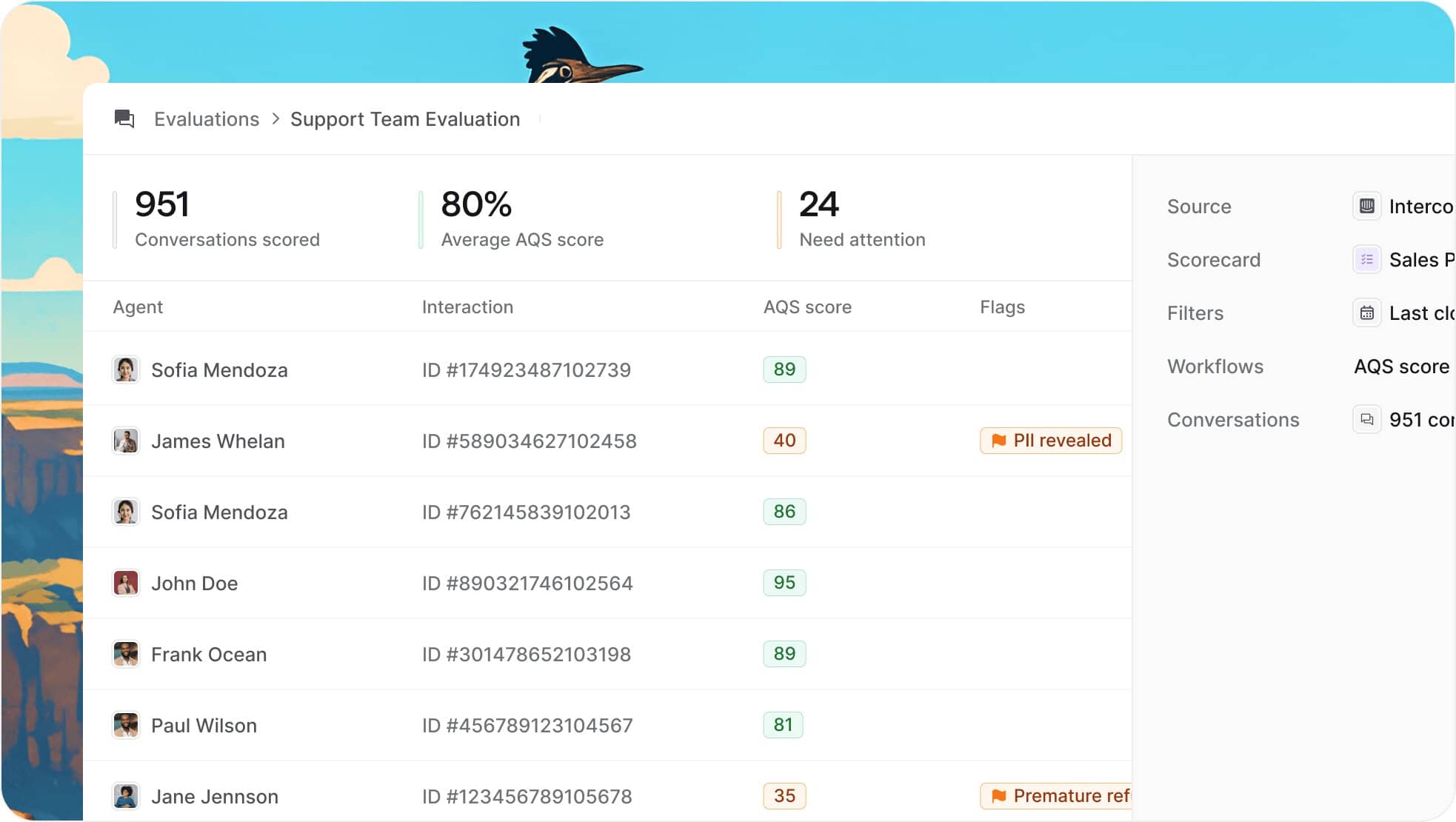
Solidroad is an AI-native QA and training platform that scores 100% of customer conversations automatically and feeds QA findings directly into personalized training simulations. It is the only tool on this list that integrates QA and training in a single platform - eliminating the gap between identifying agent skill issues and fixing them.
Where most QA software automates the scoring step but leaves training as a separate workflow, Solidroad closes the loop. QA findings trigger targeted training simulations - what the team calls a “flight simulator for agents” - auto-scored against the same custom rubrics that evaluate live conversations.
Key differentiators
100% conversation coverage. Solidroad’s automated QA scoring evaluates every interaction across phone, chat, email, and video. Based on analysis of 3 million+ conversations on the platform, full-coverage scoring delivers a 20x increase in QA coverage and a 90% reduction in QA time per interaction - nine minutes saved per manual review.
QA-to-training closed loop. QA findings from live conversations automatically trigger personalized training simulations. Agents practice realistic scenarios - across personas, channels, difficulty levels, and languages - scored against custom rubrics shaped by company SOPs. The result is 33% faster agent ramp and measurably fewer training hours per agent.
AI agent QA with hallucination detection. Solidroad monitors both human and AI agent interactions, instantly flagging high-risk AI responses containing hallucinations and errors. No other competitor on this list offers dedicated AI agent QA. As AI agents handle more frontline interactions, unmonitored AI conversations become a growingrisk.
Key capabilities
Score 100% of conversations automatically across phone, chat, email, and video.
Generate realistic training scenarios in minutes, auto-scored against custom rubrics.
Flag AI agent errors before they reach customers with real-time hallucination detection.
Detect compliance, churn, and brand risk across every interaction in real time.
Deploy custom QA scorecards aligned to company SOPs and knowledge base.
Support multi-language and multi-channel operations from a single platform.
Integrate with Zendesk, Intercom, Gladly, Gorgias, and ServiceNow via native connectors.
Access analytics dashboards with team-level and agent-level performance breakdowns.
Solidroad has scored over 3 million+ conversations on its platform. Teams at Meta, Faire, Oura, Crypto.com, Ryanair, Podium, ActiveCampaign, and Fever use the platform for QA and training. See customer stories for detailed case studies.
Implementation takes days, not months. Solidroad connects to existing helpdesk and telephony systems through native integrations, with most teams running their first automated QA evaluations within the first week.
What users say
“What I like the most is how easy to use it is. The interface is simple but contains all I need to keep track of everything. It has been helpful in our hiring and training due to the features it has. And the best part is innovation. I’ve never seen something as cool as Solidroad before.” - G2 reviewer
“The AI simulations are so closely related to actual human experience.” - G2 reviewer
“Really love the application of AI here, solving a really meaty problem which usually requires 1:1 coaching and listening to call recordings to do in any way well.” -Product Hunt reviewer
“This tool saves us so much when it comes to time and human resources, and delivers high-quality results.” - Product Hunt reviewer
As Natalia Garcia Jane, Senior Operations Manager (Customer Care) at Fever, puts it: “We now have visibility into quality across 100% of interactions, not just a sample. And when we find gaps, we can verify they’re fixed before they affect more customers.”
Limitations
Custom pricing with no public tiers means teams need a demo call for details.
One G2 reviewer noted that AI training simulations can respond before the agent finishes speaking - a timing issue in the simulation experience, not the QA scoring.
Solidroad is purpose-built for QA and training. Teams that also need workforce management, speech analytics, or gamification will need additional tools alongside it.
Pricing
Custom pricing. See how Solidroad works.
2. MaestroQA (best for customizable manual QA scorecards with structured coaching)
MaestroQA (recently rebranded to Rippit) is a QA platform for contact centers with configurable scorecards, automated workflows, coaching tools, and detailed analytics. MaestroQA validated the enterprise QA budget line - their existence proves that QA is a funded, enterprise-grade need, not a nice-to-have. The platform offers deep customization for teams that have specific, complex QA workflows and need granular control over scorecard design, but relies on manual-first QA workflows rather than full AI automation.
Key capabilities
Customizable QA scorecards with configurable evaluation criteria
Automated QA workflows for routing and assignment
Agent coaching tools with structured feedback delivery
Help desk integrations with Zendesk, Salesforce, Intercom, and Kustomer
Performance analytics and root cause analysis
Recently rebranded to Rippit with a pivot toward PLG and CX engineering
Strengths
MaestroQA offers one of the deepest scorecard customization experiences in the category. Teams can build different evaluation criteria for different conversation types - sales calls scored differently from billing disputes, chat scored differently from phone - and configure automated routing so the right reviewers see the right conversations. For teams running complex, multi-criteria QA processes, MaestroQA’s configurability is a genuine strength. The platform’s analytics layer connects QA scores to root cause analysis - helping QA managers move beyond “this agent scored low” to “here’s why and here’s where the process breaks.”
“Easy to use software that allows us to identify issues, coach agents, and measure impact. Easy to export results, create graphs and track the metrics of the agents.” - Verified User in Computer Software, via G2
Limitations
“Not user-friendly, and not intuitive to use, the metrics are lacking in ease of use and functionality, thus overall the reporting is something I dislike the most about it.” - G2 reviewer
“It has some limitations, UI is not very user friendly, we changed to Klaus because it offered a better support, it is more intuitive for the agents and also allowed us to integrate it with other softwares.” - Verified User in Computer Software, Small-Business, via G2
The structural contrast: MaestroQA helps teams review conversations better. It optimizes manual QA processes rather than replacing them. For teams that need 100% coverage or integrated training simulations, the architecture does not extend into those areas.
Pricing
Custom pricing.
3. Klaus / Zendesk QA (best for Zendesk-native teams wanting integrated QA)
Klaus (now Zendesk QA) is a conversation review and scoring tool acquired by Zendesk. It integrates QA directly into the Zendesk platform with a Chrome extension for in-ticket review. Post-acquisition, some users report regression in scorecard functionality and interface changes.
Key capabilities
Conversation Insights for ticket prioritization
Integration with Zendesk and Kustomer
Separate workspaces for team-specific rubrics
Dashboard with preliminary metrics and filter functionality
Chrome extension for in-ticket QA review
Strengths
For teams already on Zendesk, the native integration means QA managers can review and score conversations without leaving the same interface agents and managers already use - no tab-switching, no data syncing, no separate login. The Zendesk acquisition gives Klaus platform stability and long-term viability within Zendesk’s product suite.
Limitations
“Formally known as Klaus, this was a platform my client would use for the QA evaluations for the support team. However, we decided to leave this platform since the score card and reporting were changed to a new interface that did not meet our expectations.” - G2 reviewer
“Klaus use to be fun but after Zendesk acquired it, they changes were not so good. The scorecard was very limiting as well.” - G2 reviewer
Pricing
Custom pricing (bundled with Zendesk Suite plans).
4. Scorebuddy (best for QA scorecards with built-in learning management)
Scorebuddy is a purpose-built QA platform with GenAI auto-scoring, customizable scorecards, and a built-in learning management system (LMS) for agent training. Used by 50,000+ agents across 300+ contact centers, Scorebuddy bridges QA evaluation and training in one tool.
Key capabilities
GenAI auto-scoring with up to 100% coverage
Customizable scorecards for different evaluation criteria
Built-in LMS for agent training delivery
Root cause analysis for quality trends
Custom dashboards and BPO audit capabilities
Strengths
Scorebuddy is one of the few QA tools that includes a built-in LMS, and its GenAI auto-scoring can reach up to 100% conversation coverage - putting it closer to review-everything tools on the coverage dimension. Where it differs from Solidroad is in what happens after scoring: Scorebuddy delivers training through a traditional LMS, while Solidroad generates personalized simulations scored against the same rubrics used in QA. The platform serves contact centers from under 100 to over 1,000 agents.
Limitations
“As a employee, I have no overview. Very confusing layout. No feedback when I contacted the company about it. As an employee I want to have an overview with a list of all interactions of the relevant timeframe. But it is not possible.” - G2 reviewer
“The thing that I most dislike about the Scorebuddy are the data download features and report function. To be able to download full data, need to download multiple time with different selections of specific column, merge data and then clean data.” - G2 reviewer
Pricing
Custom pricing.
5. Observe.AI (best for speech analytics and compliance monitoring at scale)
Observe.AI is an AI-powered call center intelligence platform that transcribes and analyzes calls to surface compliance risks, coaching opportunities, and performance trends. It offers a broad product suite beyond speech analytics, but has faced user feedback about customer service changes and transcription accuracy.
Key capabilities
Speech analytics and real-time transcription
Compliance risk detection and monitoring
Agent coaching tools with performance tracking
Sentiment analysis and trend identification
Omnichannel support across voice and text
Real-time monitoring capabilities
Strengths
Observe.AI offers one of the broader product suites in this category - going beyond traditional QA into conversation intelligence, compliance monitoring, and real-time coaching. For regulated industries where compliance is the primary driver, Observe.AI offers purpose-built risk detection capabilities.
“A wider product offering means that speech analytics is now a sliver of their entire product catalogue. They are constantly making advancements and bugs are rarely, if ever, an issue.” - G2 reviewer
Limitations
“Their leadership must have changed somehow. Where we once had outstanding customer service, we now have long email exchanges that often end up in an upsell. The product is great, but they no longer seem to have the account managers to support it.” - G2 reviewer
“The transcriptions in Observe.AI are inaccurate.” - G2 reviewer
Pricing
Custom pricing.
6. Playvox (best for QA alongside workforce management and gamification)
Playvox is a quality management and workforce optimization platform acquired by NICE. It combines QA monitoring with workforce management, gamification, and agent engagement tools. The NICE acquisition provides platform stability but introduces enterprise complexity.
Key capabilities
Quality monitoring with gamification elements
Workforce management, including scheduling and forecasting
Agent engagement tools and performance tracking
Real-time adherence tracking
Integration with Zendesk and Five9
Strengths
Playvox is one of the few platforms that combines QA with workforce management in a single tool. For teams that need both scheduling and forecasting alongside quality monitoring, Playvox eliminates the need for separate WFM and QA platforms.
Limitations
“Playvox was incredibly clunky and had a particularly poor user interface outside of shift checking. It took forever to be implemented and despite having to use it every day, the team found it incredibly difficult to use.” - G2 reviewer
The structural question: Does your team need better scheduling or better skill development? Playvox combines QA + WFM. Solidroad combines QA + training. The answer depends on which gap costs your team more.
Pricing
Custom pricing.
7. Level AI (best for AI-driven sentiment analysis and conversation intelligence)
Level AI is an AI-driven quality assurance platform that uses semantic intelligence rather than keyword matching for conversational analysis. It provides automated QA evaluations, agent coaching, and conversational analytics with context and intent understanding.
Key capabilities
Semantic AI for context understanding beyond keyword matching
Omnichannel conversation capture across phone, chat, and email
Automated evaluation with AI-generated scoring
Agent coaching tools with detailed feedback
Custom dashboards and reporting
Real-time interaction analysis
Strengths
Level AI differentiates through semantic understanding rather than keyword spotting. For teams frustrated by QA tools that flag false positives based on keyword triggers, Level AI’s context-aware approach reduces noise and improves scoring accuracy.
“It captures data in various areas, allowing for thorough information to be pulled quickly. The ability to personalize your own dashboard with graphs and other information specific to your role is fantastic.” - G2 reviewer
Limitations
“Call ingestion is delayed by 24 hours or more, so we cannot monitor same day calls reliably. When the calls do ingest, many of them port over without audio so we have to trust the transcript is 100% as we have no way to double-check by spot-listening to the call itself.” - G2 reviewer
“It is not clear what the standards are for analyzing the call sentiment, and not necessarily a call that has been classified as negative was actually a bad one, so the numbers seem to be always off.” - G2 reviewer
Pricing
Custom pricing.
8. EvaluAgent (best for automated QA evaluation with quick helpdesk integration)
EvaluAgent is an AI-powered QA platform for contact centers that automates evaluation with insight generation, reducing the need for frequent analyst intervention. It integrates with helpdesks like Freshdesk for quick deployment.
Key capabilities
Automated QA evaluation with AI-generated insights
Agent feedback categories for structured coaching
Fast integration with helpdesks, including Freshdesk
Performance dashboards with trend tracking
Reduced subjectivity in scoring through automation
Strengths
EvaluAgent’s focus on automated evaluation and AI-generated insights reduces analyst workload. For teams that want to scale QA coverage without proportionally scaling QA headcount, the automation layer addresses the core capacity problem.
Limitations
“Inability to train the AI to check organization specific resolution requirements including escalations. This is a major requirement for us, and we hope Evaluagent can build this.” - G2 reviewer
“I cannot truly see what exactly differentiates Evaluagent from any other regular quality assurance tool.” - G2 reviewer
EvaluAgent automates the evaluation step but does not connect QA findings to training workflows. Teams that need the closed loop between quality measurement and skill development will need a separate training tool.
Pricing
Custom pricing.
9. NICE CXone (best for enterprise contact centers needing QA within CCaaS)
NICE CXone is an enterprise-grade quality management module within NICE’s contact center platform. It offers interaction analytics, workforce management, and compliance tools across all channels - designed for large organizations that need QA integrated into their existing CCaaS infrastructure.
Key capabilities
Enterprise quality management with interaction analytics
Workforce management and scheduling
Compliance monitoring across all channels
AI-powered evaluation within the NICE platform
Omnichannel support for voice, chat, email, and social
Unified reporting across QA and WFM
Strengths
NICE CXone is the enterprise standard for contact center infrastructure. For organizations already on the NICE platform, adding quality management keeps everything under one roof with unified reporting and compliance frameworks. It is the default choice for large-scale, regulated environments.
Limitations
QA is one module within a massive platform, so teams that need specialized QA may find it less focused than purpose-built alternatives. Implementation complexity matches enterprise scale: expect months, not weeks.
Pricing
Enterprise pricing (typically $100+/user/month). Custom quotes based on modules and scale.
10. Convin (best for entry-level AI-powered QA automation)
Convin is an AI-powered conversation analytics platform with automated auditing and agent performance tracking across call, chat, and email. Its entry-level pricing makes Convin accessible for smaller contact centers exploring AI-powered QA automation for the first time.
Key capabilities
AI-powered conversation analytics and auditing
Agent performance tracking across omnichannel interactions
Compliance monitoring capabilities
Automated QA scoring
Call, chat, and email coverage
Strengths
Convin makes AI-powered QA accessible to smaller teams with entry-level pricing. For call centers that want to move beyond manual QA but are not ready for enterprise pricing, Convin offers a starting point for automated conversation analysis.
Limitations
Convin has a smaller market presence than established competitors and limited English-language G2 reviews available for validation. Feature depth may not match enterprise-grade platforms for complex QA workflows.
Pricing
Entry-level pricing available. Contact Convin for details.
How to choose the right contact center quality assurance software
Choose contact center QA software based on your team’s QA maturity, not features. A team sampling 1-5% of conversations needs a different tool than a team already at 100% automated coverage. Start by asking: How many conversations does your current QA process actually review?
Your situation | What to prioritize | Tools to evaluate |
|---|---|---|
Manual QA, sampling 1-5% | Coverage rate - move from sampling to full coverage | Solidroad, Scorebuddy, EvaluAgent |
Already using a QA tool but QA and training are separate | QA-to-training integration - close the loop | Solidroad, Scorebuddy |
Deploying AI agents alongside human agents | AI agent QA - Who monitors the AI? | Solidroad |
Locked into Zendesk platform | Native integration - reduce tool sprawl | Klaus (Zendesk QA) |
Enterprise CCaaS with compliance requirements | Platform consolidation - QA within your existing stack | NICE CXone, Observe.AI |
Need QA + workforce management in one tool | WFM integration | Playvox |
The right tool depends on where your team sits today and where you need to be in 12 months. Feature checklists compare tools within a category. They don’t help you decide whether to optimize manual review or replace it entirely.
Frequently asked questions
What is the difference between quality assurance and quality management in a call center?
Quality assurance evaluates individual interactions against specific criteria: Did the agent follow the script, resolve the issue, and maintain compliance? Quality management is the broader governance framework that includes QA, training, workforce optimization, and process improvement. QA is one component within quality management. Most tools on this list focus on QA specifically, though platforms like NICE CXone and Playvox bundle QA with workforce management capabilities.
How much does call center QA software cost?
It depends. Most vendors offer custom pricing with no public tiers, making direct comparison difficult. Pricing models vary: per-agent, per-seat, per-conversation, or platform fees. Entry-level tools start under $20 per agent per month. Enterprise platforms like NICE CXone typically run $100+ per user per month. The total cost of ownership includes implementation, training, and the ongoing time your QA team spends managing the tool - not just the subscription fee.
What percentage of calls should be monitored for quality assurance?
Every call center should target 100% call coverage with automated QA tools. Manual QA teams typically sample 1-5% of conversations - far too few to catch compliance risks, churn signals, or coaching opportunities consistently. In our State of CX 2026 survey, 81% of agents said most conversations are never reviewed. Automated scoring platforms eliminate the sampling bottleneck, evaluating every interaction against custom rubrics without adding QA headcount.
How does AI improve call center quality assurance?
AI transforms QA from sample-based to census-based. Instead of human reviewers listening to a handful of calls, AI scores 100% of conversations automatically - flagging compliance risks, detecting sentiment patterns, and identifying coaching opportunities in real time. AI also enables pattern detection at scale: trends across thousands of conversations that no human reviewer could identify from a 2% sample.
Can QA software monitor AI agents and chatbots?
Most cannot. The majority of QA software was built to evaluate human agent conversations and does not extend to AI agent monitoring. As companies deploy AI agents for frontline support, a new requirement emerges: detecting hallucinations, factual errors, and policy violations in AI-generated responses. Solidroad is one of the few platforms that offers dedicated AI agent QA with hallucination detection, monitoring both human and AI agent interactions on the same platform.
What is the difference between manual QA and automated QA in a call center?
Manual QA relies on human reviewers listening to or reading a sample of conversations - typically 1-5% - and scoring them against rubrics. Automated QA uses AI to score 100% of conversations without human review. The coverage difference is the critical factor: manual QA guesses quality from a small sample, while automated QA evaluates every interaction. Teams using manual QA are making quality decisions based on 1-5% of the data. Automated QA eliminates that statistical gamble.
Two categories, one decision
Contact center QA software falls into two categories: review-better tools that optimize manual QA and review-everything tools that eliminate the bottleneck. Every vendor claims the second category. The evidence - 81% of agent conversations never reviewed, coverage rates stuck at 1-5%, QA and training operating as separate silos - suggests most vendors still sit in the first category.
A longer feature checklist does not move a review-better tool into review-everything territory. What matters is whether the platform fundamentally changes how many conversations get reviewed, whether quality findings translate into training, and whether the system extends to AI agents - not just human ones.
For teams ready to move from sampling to census, from measurement to action, and from human-only QA to human-plus-AI agent QA, that architectural difference is the decision that matters.
See how Solidroad works
Solidroad scores 100% of conversations automatically and feeds QA findings directly into personalized training. If your team is ready to close the gap between quality measurement and skill development, see how Solidroad works.