


Key Takeaways
81% of customer conversations are never reviewed (State of CX 2026 survey, 500 agents) - a coverage gap that compounds faster in ecommerce, where seasonal spikes multiply volumes.
Ecommerce teams deploying AI agents should prioritize QA tools that monitor both human and AI responses - a gap that no competing guide in this space addresses.
Solidroad leads ecommerce QA because it scores chat, email, phone, and AI agent conversations equally - most quality assurance software prioritizes voice and treats digital channels as secondary.
Solidroad connects QA findings directly to personalized agent training - the only platform on this list that closes the gap that 53.5% of agents say is their biggest challenge.
In our State of CX 2026 report - a survey of 500 customer support agents - we found that 81% of conversations are never reviewed. For ecommerce teams handling 10,000+ interactions per month across chat, email, and phone, that coverage gap scales faster than it does for phone-only operations.
Based on analysis of more than 3 million conversations on our platform, the pattern is consistent: Teams that score 100% of conversations catch compliance risks and churn signals that manual sampling misses entirely.
Solidroad tops this list because ecommerce support runs on chat and email, yet most QA tools were built for phone-first contact centers. And Solidroad is the only platform here that treats every channel, including AI agents, as a first-class QA surface.
This guide covers 10 QA tools evaluated on the criteria that matter most for ecommerce: omnichannel scoring depth, QA-to-training integration, AI agent QA capability, and seasonal scaling. Solidroad is our platform, and it appears first in this list. We’ve included honest limitations alongside strengths for every tool.
Ecommerce QA at a glance
The best QA software for ecommerce scores chat, email, and phone conversations with equal depth, integrates with ecommerce support platforms like Gladly and Gorgias, and connects QA findings to agent training. This comparison table evaluates 10 tools on these dimensions.
Tool | Omnichannel scoring | Ecommerce integrations | QA-to-training pipeline | Seasonal scaling |
|---|---|---|---|---|
Solidroad | Scores chat, email, phone, and video with equal depth. AI agent conversations included as first-class QA surface | Gladly, Gorgias, Zendesk, Intercom, Help Scout, ServiceNow | QA findings auto-trigger personalized training simulations; only platform integrating QA scoring and agent training in a single product. | 100% automated coverage maintained at scale. 20x QA coverage increase vs. manual sampling without additional QA headcount |
MaestroQA | Supports voice, chat, and email review through manual evaluation workflows | Salesforce, Zendesk, Intercom | Manual coaching workflows triggered by QA findings. No automated training pipeline | Manual QA process - coverage scales linearly with QA headcount |
Klaus/Zendesk QA | AI scoring across channels within the Zendesk ecosystem | Zendesk (native), Kustomer | Coaching tools within Zendesk; no automated training simulations | AI-assisted scoring within Zendesk infrastructure |
Scorebuddy | GenAI Auto Scoring across supported channels | Integrates with major support platforms | Reports and dashboards;manual coaching only | Automated scoring handles volume increases |
Observe.AI | Strong voice analytics with speech-first architecture; chat and email scoring secondary | Integrates with enterprise contact center platforms | Coaching workflows from QA insights; no automated training | AI-powered monitoring scales with volume |
EvaluAgent | Evaluation workflows across supported channels | Freshdesk integration | Coaching tools integrated with QA; no AI-powered training simulations | Auto QA capabilities help manage volume increases |
Playvox | Quality management across channels within supported ecosystems | Salesforce, Zendesk | Performance tracking and coaching; no automated training pipeline | Workforce management helps plan for volume spikes |
Level AI | AI-powered conversation analysis across channels | Integrates with major support platforms | Agent coaching recommendations from QA data; no automated training | AI-native scoring architecture |
CallMiner | Advanced speech analytics with NLP; chat and email analysis secondary | Enterprise contact center integrations | Analytics and reporting; manual coaching process | Enterprise-scale processing capability |
NICE CXone | 100% interaction recording across all channels | 40+ app integrations | Coaching tools within the broader platform; no integrated training simulations | Enterprise-grade infrastructure built for high volume |
How to evaluate QA software for ecommerce
Most QA buyer’s guides evaluate reporting, integrations, and ease of use - criteria that apply to any contact center.
Ecommerce is different. Your support runs on chat and email, you hire seasonally, and you’re likely deploying AI agents no one is monitoring.
Four criteria separate tools built for this reality from phone-first platforms: omnichannel scoring depth across chat, email, and phone; whether QA findings feed into automated agent training; AI agent QA capability; and seasonal scaling to maintain coverage during volume spikes without adding QA headcount.
Omnichannel coverage beyond voice
Ecommerce contact centers handle most interactions via chat and email, not phone. The best QA tools for ecommerce score digital channels with the same depth as voice - analyzing tone, policy compliance, and resolution quality across every channel.
Most quality assurance platforms were built for voice first and bolted on chat and email later. “Supports omnichannel” on a feature list doesn’t mean “scores omnichannel with equal depth.”
A tool that transcribes phone calls with full sentiment analysis but reduces chat conversations to keyword tagging isn’t scoring with equal depth - it’s checking a box. For ecommerce teams where chat and email represent the majority of customer interactions, that gap means the highest-volume channels get the shallowest review.
QA-to-training integration
The strongest QA platforms for ecommerce connect QA findings directly to targeted agent training - closing the gap between identifying problems and fixing them. Our survey found that 53.5% of agents say the hardest part is applying training to real situations.
Every QA platform on this list can tell you which agents need improvement. The question is what happens next. In most tools, QA findings go into a report. A manager reviews the report and schedules a coaching session, which the agent attends. Weeks pass between identifying the problem and addressing it.
For ecommerce teams with high turnover and seasonal hiring cycles, that delay is costly - every new hire needs to ramp faster, and QA findings that sit in reports instead of triggering training waste the narrow window before the next volume spike.
AI agent QA capability
Ecommerce teams are among the first to deploy AI agents for customer support. AI agent responses contain incorrect or incomplete information 15–57% of the time (State of CX 2026) - but almost no QA tool on the market monitors them.
Every tool on this list mentions AI as a feature of the QA tool - AI-powered scoring, AI-assisted coaching, AI analytics. Almost none of them discuss QA of AI agents. QA software that only monitors human conversations misses a growing share of customer interactions - look for tools that score both human and AI responses.
As ecommerce teams deploy chatbots from providers like Decagon and Sierra, they need a QA layer that catches hallucinations, policy violations, and tone drift in AI-generated responses. Traditional QA frameworks built for human conversations don’t catch AI-specific failure modes. Human agents forget steps or lose patience. AI agents fabricate product details that sound authoritative and apply return policies differently to identical situations.
Seasonal scaling and coverage consistency
Ecommerce contact centers face dramatic seasonal volume spikes during Black Friday and holiday periods - Salesforce data from the 2025 holiday season showed customer service interactions jumped 126% compared to the two months prior.
QA software must maintain coverage during these spikes because the risk compounds: Higher volumes mean more new or seasonal agents handling more conversations with less oversight. Drop from 100% to sample-based QA during your highest-traffic month, and compliance violations, refund errors, and churn signals pass through undetected at scale. That’s the test that separates AI-native tools from manual-first platforms.
What “100% coverage” means changes at ecommerce scale. A team handling 10,000 interactions monthly can maintain manual QA. That same team during Black Friday - handling 50,000 to 100,000 interactions - can’t hire 5–10x more QA analysts for a two-week spike. Automated scoring is table stakes because the alternative is quality monitoring dropping to near zero when it matters most.
The 10 best contact center QA software for ecommerce
The best QA software for ecommerce in 2026 includes Solidroad for integrated QA and training, MaestroQA for structured manual QA workflows, Klaus/Zendesk QA for Zendesk-native teams, and Scorebuddy for flexible AI auto-scoring.
1. Solidroad - Best for ecommerce teams needing integrated QA + training with 100% conversation coverage
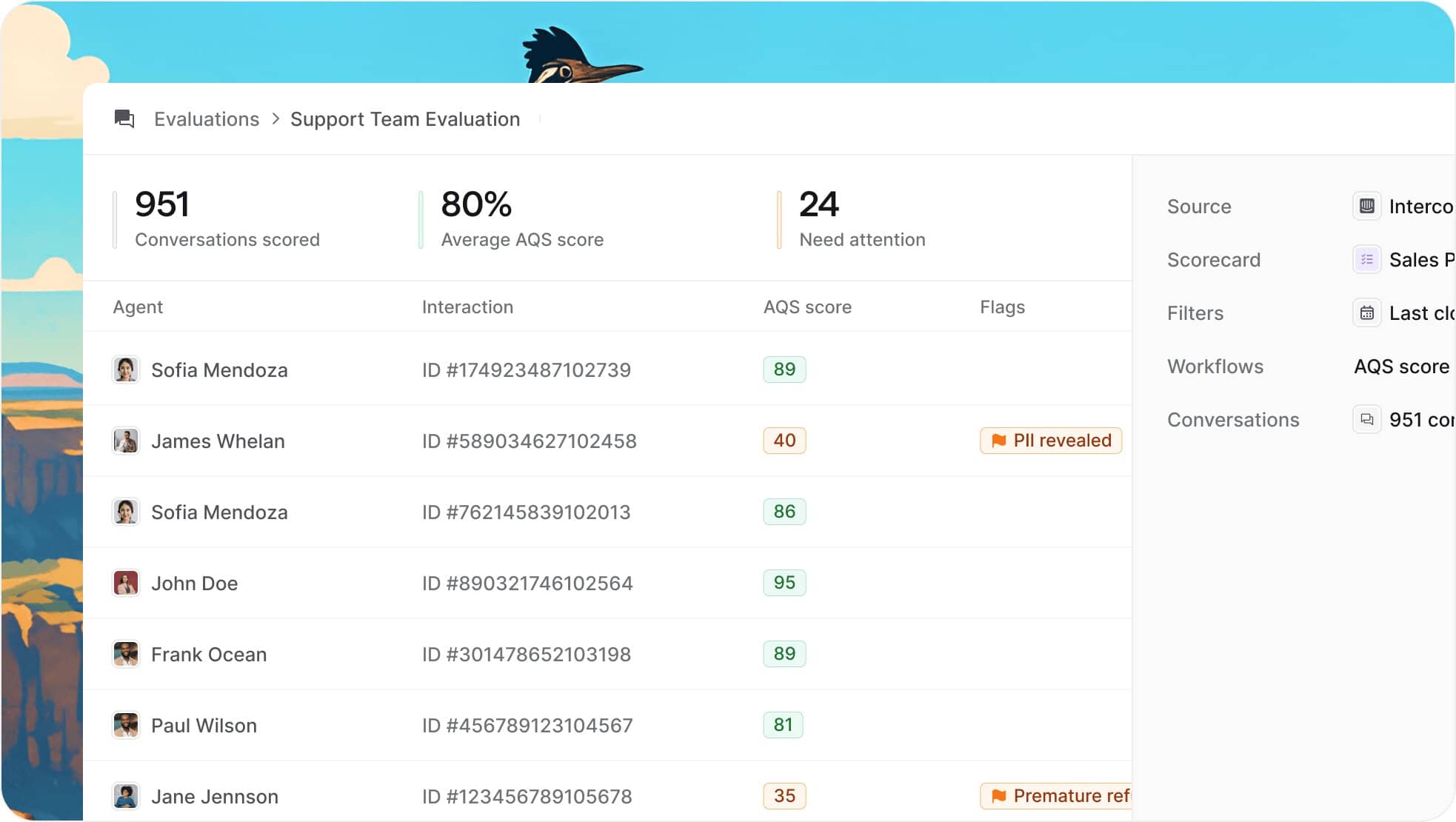
Solidroad is an AI-native QA and training platform that scores 100% of customer interactions - chat, email, phone, and AI agent conversations - and connects QA findings directly to personalized agent training simulations. Solidroad is the best choice for ecommerce teams because it was built for the channel mix ecommerce support actually uses.
Key capabilities
Automated QA scoring across 100% of chat, email, phone, and video conversations - replacing manual QA that covers only 1–5% of interactions
AI-powered training simulations that function as a “flight simulator for agents” - auto-scored against custom scorecards shaped by company guidelines and SOPs
AI agent QA with hallucination detection - scores both human and AI conversations, flagging incorrect or incomplete AI responses instantly
Real-time risk detection for compliance, churn, and brand risk across all channels
Ecommerce support tool integrations: Gladly, Gorgias, Zendesk, Intercom, Help Scout, and ServiceNow
SOC 2 Type 2 certified and ISO 27001 certified
E-commerce teams at Ollie, Oura, Butternut Box, and Ooni use Solidroad for QA and training. These teams increased QA coverage by 20x after switching to automated scoring - moving from reviewing a handful of interactions per agent per month to scoring every customer conversation automatically.
Key differentiators
Solidroad is the only platform on this list where QA findings automatically trigger personalized training simulations. Finding problems and fixing them are usually two separate platforms and two separate budgets - competitors do QA or training, but not both.
Our survey data shows that 82.5% of agents feel prepared when they start their role, but 53.5% say the hardest part of their jobs is applying training to real conversations. Solidroad closes that gap: Agents who complete QA-triggered training simulations ramp 33% faster, with immediate feedback on each scenario.
Teams that use Solidroad report an 80% reduction in training build time because simulations are generated from actual conversation data, not built manually. Instead of building training scenarios from scratch, teams use real QA-flagged conversations as the basis for each simulation.
Ecommerce teams are furthest along in deploying AI chatbots for customer support - but most have no QA layer for AI agent responses. AI agents respond with incorrect or incomplete information 15–57% of the time (State of CX 2026). Solidroad scores both human and AI agent conversations, catching hallucinations, policy violations, and tone drift before they reach more customers.
Solidroad has scored over 3 million customer interactions - a proprietary dataset that improves scoring accuracy as it grows. Teams using the platform report a 20x increase in QA coverage and 90% less time reviewing interactions compared to manual QA processes.
Ecommerce-specific QA considerations
Returns and refund conversations are the highest-volume interaction type in ecommerce support. QA rubrics for ecommerce teams should include specific criteria for these conversations: policy compliance, empathy scoring, and resolution accuracy for exchanges, refunds, and warranty claims.
Solidroad’s custom scorecards let teams build rubrics tailored to these high-frequency conversation types. During seasonal spikes, automated scoring maintains 100% coverage without additional QA headcount - a capability that matters most during the periods when quality risk is highest.
Implementation
Solidroad’s implementation follows an eight-phase rollout with go-live at week five, including discovery, platform configuration, security review, integrations, and testing. Teams typically see QA coverage increase from 1–5% to 100% within the first month of automated scoring.
Limitations
Newer platform with a smaller review footprint than established competitors like MaestroQA or NICE CXone (three G2 reviews vs. hundreds for incumbents)
Custom pricing only - no self-serve tier or published pricing for smaller teams to evaluate independently
Some reviewers note that AI simulations “do not wait for my complete response before AI responds” - real-time conversation pacing in simulations is still being refined
G2 reviews
“What I like the most is how easy to use it is. The interface is simple but contains all I need to keep track of everything. It has been helpful in our hiring and training due to the features it has. And the best part is innovation. I’ve never seen something as cool as Solidroad before.” - G2 reviewer
“The AI simulations are so closely related to actual human experience.” - G2 reviewer
“This tool saves us so much when it comes to time and human resources, and delivers high-quality results. We look forward to continuing to incorporate this into all our training and enablement programming for more effective, practical, and measurable results.” - Product Hunt reviewer
“Really love the application of AI here, solving a really meaty problem which usually requires 1:1 coaching and listening to call recordings to do in any way well.” - Intercom, via Product Hunt
2. MaestroQA - Best for structured manual QA workflows with customizable scorecards
MaestroQA (recently rebranded to Rippit) offers customizable scorecards, calibration tools, and CRM integrations. It’s best for teams that want detailed control over their QA process and are willing to invest in manual review infrastructure.
Key capabilities
Customizable scorecards with calibration tools for QA team alignment
CRM integrations with Salesforce, Zendesk, and Intercom
Screen capture for multi-system workflows
Coaching workflows integrated with QA scoring
Strengths
MaestroQA’s scorecard customization and calibration tools give QA teams detailed control over evaluation criteria: how questions are weighted and how calibration keeps graders consistent. For teams invested in manual QA workflows, MaestroQA is well-proven with enterprise ecommerce clients.
Limitations
MaestroQA’s QA workflows remain labor-intensive. AI features are layered onto a manual-first architecture rather than being foundational. For ecommerce teams running chat-first support at scale, coverage scales linearly with QA headcount - a bottleneck during seasonal spikes.
“Not user-friendly, and not intuitive to use, the metrics are lacking in ease of use and functionality, thus overall the reporting is something I dislike the most about it.” - G2 reviewer
3. Klaus/Zendesk QA - Best for Zendesk-native teams needing in-platform QA
Klaus (now Zendesk QA) gives Zendesk users in-platform quality management with evaluation forms, AI scoring, team calibration, and performance reporting natively built into the Zendesk support stack.
Key capabilities
Native Zendesk integration with evaluation workflows inside the support platform
AI-powered Conversation Insights for automated quality scoring
Calibration tools for QA team alignment
Kustomer integration also available
Strengths
For teams that already use Zendesk, Klaus/Zendesk QA eliminates the friction of switching between QA and support tools. QA evaluators work inside the same interface agents use, reducing context-switching. The native integration means faster implementation.
Limitations
Klaus/Zendesk QA only works inside Zendesk. Ecommerce teams using Gladly, Gorgias, or Intercom can’t use it without switching their support platform.
“Formally known as Klaus, this was a platform my client would use for the QA evaluations for the support team. However, we decided to leave this platform since the score card and reporting were changed to a new interface that did not meet our expectations.” - G2 reviewer
4. Scorebuddy - Best for flexible scorecards with AI auto-scoring at an accessible price point
Scorebuddy is a contact center QA platform that offers flexible scorecards, GenAI Auto Scoring, personalized dashboards, and real-time analytics for contact centers of all sizes.
Key capabilities
GenAI Auto Scoring for automated evaluation across conversations
Customizable scorecards with flexible evaluation criteria
Real-time analytics and reporting dashboards
Agent dashboards for self-improvement and performance tracking
Strengths
Scorebuddy’s scorecard system lets teams build the same custom rubrics they’d use for manual QA - sections, weighted questions, N/A options - then run them through GenAI Auto Scoring against every conversation automatically. That makes it a natural bridge for teams moving from manual to automated QA: same evaluation criteria, different engine.
Scorebuddy also offers tiered packages (Foundation, Accelerate, and Enterprise) with GenAI Auto Scoring available as an add-on and a 14-day free trial - a lower barrier to entry than the custom-pricing-only model most competitors on this list use.
Limitations
Scorebuddy focuses on QA scoring and reporting. It doesn’t connect QA findings to agent training - the gap between identifying a problem and fixing it remains a manual process.
Scorebuddy’s GenAI Auto Scoring handles multiple channels, but ecommerce teams running chat-first support should verify that chat scoring depth matches voice scoring depth - the channel-mix gap that separates tools built for phone from tools built for digital.
“The thing that I most dislike about the Scorebuddy are the data download features and report function. To be able to download full data, need to download multiple time with different selections of specific column, merge data and then clean data.” - G2 reviewer
5. Observe.AI - best for voice-first contact centers needing AI agents plus automated QA
Observe.AI is an AI-powered contact center platform offering voice-first AI agents, automated QA, real-time compliance monitoring, and AI Copilots for agent assistance.
Key capabilities
Voice-first AI agents for handling routine contact center calls
Automated QA monitoring across customer interactions
Real-time compliance monitoring for regulated industries
AI Copilots for live agent assistance during calls
Strengths
Observe.AI combines AI-powered QA with its own AI agents - so the same platform handling customer calls can also score them. For voice-heavy contact centers, that eliminates the integration gap between the AI doing the work and the QA layer checking it. In healthcare and finance, where compliance monitoring requires real-time flagging of regulatory violations during live calls, Observe.AI’s speech analytics can catch issues as they happen rather than in post-call review.
Limitations
Observe.AI is voice-first - built for phone-heavy contact centers. For ecommerce teams where chat and email dominate, the platform’s architecture reflects its phone-first heritage.
Observe.AI also builds its own AI agents, which means its QA layer is designed around its own models. Ecommerce teams already using AI agents from providers like Decagon or Sierra need a QA tool that monitors any AI agent, not just the vendor’s own.
“Their leadership must have changed somehow. Where we once had outstanding customer service, we now have long email exchanges that often end up in an upsell.” - G2 reviewer
“The transcriptions needs a lot of work. In my field, there are times that we work with multiple tools and it would be convenient if there is a way to collectively have connected calls.” - G2 reviewer
6. EvaluAgent - Best for mid-large teams needing QA + coaching + agent engagement
EvaluAgent offers evaluation workflows, coaching tools, and Auto QA with Freshdesk integration for mid-sized to large ecommerce businesses.
Key capabilities
Evaluation workflows with structured grading criteria
Coaching tools integrated with QA findings
Auto QA capabilities for automated scoring
Freshdesk integration completed in minutes
Strengths
EvaluAgent combines QA with coaching and agent engagement in a single platform. Fast Freshdesk integration makes it practical for mid-sized ecommerce teams that want to get started quickly.
“The tool is easy to use, and implementation was fast and effective. Integration with Freshdesk was completed in minutes. There are a vast array of functions and features, and I especially love the insight generation.” - G2 reviewer
Limitations
EvaluAgent offers coaching but not AI-powered training simulations. The platform provides workflows for identifying improvement areas and facilitating coaching conversations, but the step from “Here’s what needs to improve” to “Here’s a realistic practice scenario” remains manual.
EvaluAgent’s marketing covers multiple channels, but the platform doesn’t publish details on how its Auto QA scores chat and email compared to voice. For ecommerce teams where digital channels represent most interactions, that’s a gap worth probing in a demo - ask to see a scored chat conversation side by side with a scored call.
“I cannot truly see what exactly differentiates Evaluagent from any other regular quality assurance tool.” - G2 reviewer
7. Playvox - Best for Salesforce or Zendesk teams wanting QA + workforce management
Playvox is a workforce management and quality platform for contact centers. It combines scheduling, AI-powered forecasting, QA evaluation tools, and gamification with deep Salesforce and Zendesk integration.
Key capabilities
Quality management with structured evaluation tools
Workforce management and AI-powered scheduling
Performance tracking and gamification
Deep Salesforce and Zendesk integration
Strengths
Playvox puts QA scores and workforce scheduling in the same platform - so a team lead can see which agents are underperforming on quality and adjust their schedules, coaching sessions, or shift assignments without switching tools. For large contact centers managing 100+ agents across shifts, that single view reduces the coordination overhead between QA managers and workforce planners.
Limitations
Playvox bundles QA with workforce management - useful if you need both, but the QA capabilities are part of a broader suite rather than a dedicated QA product. Ecommerce-specific support platforms like Gladly and Gorgias are absent from Playvox’s integration story, limiting its fit for teams running modern ecommerce support stacks.
Playvox’s deep Salesforce and Zendesk integrations reflect its contact center heritage. Ecommerce teams running primarily on chat and email through platforms like Gorgias or Gladly face the same channel-mix mismatch - the tool was designed for a different support model.
“Playvox was incredibly clunky and had a particularly poor user interface outside of shift checking. It took forever to be implemented and despite having to use it every day, the team found it incredibly difficult to use.” - G2 reviewer
8. Level AI - Best for real-time AI-powered QA and conversation analytics
Level AI uses generative AI and NLP to analyze customer interactions in real time, offering AI-powered QA scoring, conversation analytics, and sentiment detection for mid-sized contact centers.
Key capabilities
AI-powered QA with generative AI and NLP for automated scoring
Real-time conversation analytics and pattern detection
Agent coaching recommendations based on QA data
Customizable dashboards with sentiment detection
Strengths
Level AI uses generative AI to score conversations rather than rule-based rubrics, meaning it can evaluate criteria like empathy or problem-solving that are hard to capture in a checkbox scorecard. Customizable dashboards let operations teams filter performance data by agent, team, channel, or time period, so managers can spot whether a pattern is systemic or isolated to a specific shift or queue.
Limitations
Level AI focuses on conversation analytics and QA scoring, but doesn’t connect QA findings to automated agent training. The gap between identifying a problem and fixing it stays manual.
G2 reviewers report a 24-hour call ingestion delay, meaning scores arrive a day after the conversation happens. During a Black Friday spike, that’s a day of unmonitored interactions piling up before anyone sees the data. Level AI’s core strength is voice analytics, and its chat and email scoring capabilities aren’t documented to the same depth on its site. For ecommerce teams where digital channels represent the majority of interactions, that’s a gap in the product’s public positioning rather than a confirmed weakness - but it’s one worth asking about directly.
“Call ingestion is delayed by 24 hours or more, so we cannot monitor same day calls reliably. When the calls do ingest, many of them port over without audio so we have to trust the transcript is 100%.” - G2 reviewer
9. CallMiner - Best for large contact centers with dedicated analyst teams
CallMiner is a conversation intelligence platform using AI and NLP for sentiment detection, root cause analysis, and behavioral analytics across large contact center operations.
Key capabilities
Advanced conversation intelligence with NLP
Root cause analysis for identifying systemic issues
Sentiment detection and behavioral analytics
Enterprise-scale insight discovery and reporting
Strengths
CallMiner goes deeper into conversation analytics than most tools on this list. It can run sentiment detection, root cause analysis, and behavioral pattern matching across millions of calls to surface systemic issues (like a specific return policy causing repeat complaints).
That depth requires dedicated analysts to configure and interpret, which is why it fits large contact centers with 500+ agents and a team whose job is mining conversations for compliance risks and operational patterns.
“I really appreciate transcripts for quick review of call content and finding the point(s) in a call I want to zero in on. I also love how customizable the tool is.” - G2 reviewer
Limitations
CallMiner’s enterprise focus means custom pricing for large contact centers with 500+ agents. Implementation complexity may be prohibitive for mid-sized ecommerce teams.
The platform’s strength is speech analytics, and CallMiner’s site focuses almost entirely on voice use cases. Chat and email analysis isn’t featured prominently in their product documentation - a signal that digital channels may receive lighter treatment than voice. For ecommerce teams running most interactions through chat and email, a speech-analytics-first platform is solving the wrong channel problem.
Reviewers report transcription accuracy issues, including difficulty with regional accents and brand names - a significant concern for ecommerce teams serving diverse customer bases across geographies.
“The transcription is of poor quality, and the boolean operators are finicky and do not work as they should. It’s unfortunate because when you’re dealing with a large volume of calls, advanced boolean searches are integral to workflow.” - G2 reviewer
10. NICE CXone - Best for enterprise QA, WFM, and compliance in one platform
NICE CXone is an enterprise contact center platform capturing 100% of interactions, with AI-powered QA, interaction analytics, workforce management, and compliance tools.
Key capabilities
100% interaction recording at enterprise scale
AI-powered QA evaluation and scoring workflows
Workforce management and scheduling
40+ app integrations, including Salesforce, Oracle, Microsoft Dynamics, Zendesk, and ServiceNow
Strengths
NICE CXone has been in the contact center market for over two decades and has over 1,700 G2 reviews - more than every other tool on this list combined. For enterprise teams, that track record means proven integrations with legacy infrastructure (Salesforce, Oracle, ServiceNow) and a platform that’s been stress-tested at scale. NICE CXone also publishes pricing ($110+/agent/month) - uncommon in a category where almost every competitor requires a sales call to get a number.
“I do like that an entire suite of services is provided.” - Verified User in Security and Investigations, via G2
Limitations
NICE CXone’s enterprise scale means the platform is typically overbuilt for mid-sized ecommerce teams. The breadth of capabilities (QA + workforce management + analytics + compliance) means no single capability goes as deep as a dedicated tool.
NICE CXone’s forecasting capabilities are voice-only. For ecommerce contact centers where chat and email represent the majority of interactions, the inability to forecast across digital channels undermines the platform’s omnichannel positioning. Reviewers also flag hidden costs that surface after purchase.
“You can’t forecast for email or chat; you can only forecast for voice! We got this tool under the impression that we’d be able to forecast all our channels. Feels like a bait-and-switch.” - Adam K., Workforce Manager, via G2
Gladly and Gorgias are not listed in NICE’s CXexchange marketplace. For ecommerce teams running support through either platform, that’s a dealbreaker without a custom integration.
How to choose the right QA software for your ecommerce team
To find the QA software that matches your team’s needs, match your channel mix, training needs, AI agent deployment status, and seasonal scaling requirements to each tool’s capabilities. For example, teams running primarily on chat and email need a tool that scores digital channels with the same depth as voice.
This table maps five common ecommerce team profiles to the tool that fits each one best. Find the row that matches your situation - it narrows 10 options to one starting point.
Your team profile | Evaluate first |
|---|---|
Chat and email-first ecommerce team, 10K+ monthly interactions, deploying AI agents | Solidroad - integrated QA + training, AI agent QA, omnichannel scoring |
Zendesk-native team wanting in-platform QA without adding another vendor | Klaus/Zendesk QA - native integration eliminates context-switching |
Established QA team invested in manual workflows wanting incremental improvement | MaestroQA - structured scorecards, calibration, enterprise-proven |
Mid-sized team transitioning from manual to automated QA on a budget | Scorebuddy - flexible scorecards, GenAI Auto Scoring, tiered pricing |
Enterprise contact center needing QA + WFM + compliance in one platform | NICE CXone - broadest feature set, established infrastructure |
Before evaluating any QA platform, audit your channel distribution. If 70%+ of interactions happen via chat and email, prioritize tools that score digital channels with equal depth to voice.
When you’re evaluating vendors, be sure to ask these questions:
What percentage of your customers use your platform primarily for chat and email QA? A vague or low answer tells you the product was built for voice, and chat is an afterthought. You want a vendor whose customer base mirrors your channel mix.
Can you show me chat scoring beyond keyword tagging? Keyword tagging checks whether certain words appeared. Depth means evaluating tone, policy compliance, and resolution quality on a chat transcript the same way you’d score a phone call.
How does your platform handle AI agent conversations? Most vendors will say “We use AI” - that’s not the same thing. You’re asking whether the tool can monitor your AI agents for hallucinations and policy violations, not whether the QA tool itself is AI-powered.
Frequently asked questions
What is contact center quality assurance software?
Quality assurance software for contact centers automates the process of evaluating customer interactions by scoring agent performance on criteria like policy compliance, tone, resolution quality, and customer satisfaction across phone, chat, and email channels.
For ecommerce teams, QA software is especially important because interaction volumes fluctuate with seasonal demand, and maintaining consistent quality across 10,000+ monthly conversations needs automated scoring rather than manual sampling.
How does AI improve contact center quality monitoring?
AI transforms quality monitoring from sample-based to full-coverage by automatically scoring every conversation against custom rubrics. Rather than QA analysts manually reviewing 1–5% of interactions, AI-powered monitoring evaluates 100% of conversations in real time.
The emerging frontier is AI agent QA - using AI to monitor AI-generated responses for hallucinations and policy violations. Solidroad, for example, integrates automated QA scoring with personalized coaching, connecting quality findings directly to agent training.
How long does IT take to implement contact center QA software?
Implementation timelines range from days to months, depending on platform complexity and your existing infrastructure. Simpler tools with direct integrations can be operational within one to two weeks.
Enterprise platforms like NICE CXone typically need multi-month implementations with dedicated project teams. Solidroad's implementation follows an eight-phase rollout with go-live at week five.
How do you choose QA software for ecommerce customer support?
Start with your channel mix. Ecommerce teams typically handle the majority of interactions via chat and email, not phone - so the QA tool must score digital channels with equal depth, not treat them as secondary.
Evaluate seasonal scaling capability (can coverage hold at 3–10x volume during Black Friday?), ecommerce platform integrations (Gladly, Gorgias, Zendesk), and whether QA findings connect to agent training or stop at reports.
Can QA software monitor both human and AI agent conversations?
It depends. Most QA tools on the market today monitor only human agent conversations. As ecommerce teams deploy AI chatbots for customer support, this creates a growing blind spot.
A small number of platforms now offer AI agent QA that scores both human and AI responses against the same quality criteria, flagging hallucinations and policy violations in real time.
Ecommerce support needs QA that matches how customers actually reach you
The best QA software for ecommerce matches the channel mix of modern ecommerce support - primarily chat and email, and increasingly, AI agents. Tools designed for phone-first contact centers score digital channels as an afterthought, creating a coverage gap that widens as ecommerce support evolves.
Ecommerce is the vertical furthest along in deploying AI agents for customer support - and AI agent deployment introduces a new category of quality risk that phone-first QA tools have no framework to address.
Hallucination detection, policy compliance monitoring for AI-generated responses, and consistency scoring across human and AI interactions aren't features that can be bolted onto a legacy architecture. These capabilities need a QA platform built for how ecommerce support operates today and where it's heading.
See how Solidroad works
Solidroad scores 100% of your customer interactions - chat, email, phone, and AI agent conversations - and connects QA findings directly to personalized training simulations. See how Solidroad works to find out how ecommerce teams at Ollie, Oura, and Butternut Box increased QA coverage by 20x without adding QA headcount.


